The Belly Gap Fix All postpartum mom's Wish They’d Known Sooner
The 500-Year-Old 360° Bengkung Method Helping New Mothers Close The 'Post-Baby Belly Gap' In Just 21 Days. If your post-baby belly pooch refuses to go in no matter how many core workouts or velcro waist cinchers you try, doctors warn standard shapewear is actually making it worse. Here is the gentle Malaysian 360° wraparound technique restoring maternal abdominal walls worldwide.

You slide one leg in, then the other, pull them over your hips, and try to pull up the zipper. The metal zipper stops dead—four full inches apart.
You suck in your breath until your lungs burn, but the denim will not budge. With a heavy, familiar sigh, you let go, drop the jeans into the laundry basket, and quietly pull on the same oversized black maternity leggings for the sixth day in a row.
As you glance sideways at the soft, rounded bulge sitting below your navel—the one that still makes well-meaning strangers ask 'When are you due?' even though your baby is eight months old—your heart sinks. You love your baby more than life itself, but a quiet, aching question echoes in your chest: 'Will my body ever feel like mine again?'
What The 'Mommy Pooch' Is Quietly Robbing From You Every Single Day
1. Photo Avoidance & Memory Erasure
Stepping out of family snapshots or insisting on holding the baby directly in front of your midsection to block the camera lens. Looking back at milestone albums with hundreds of pictures of your child—and almost none of you.
2. Wardrobe Exile & Loss of Identity
80% of your pre-pregnancy clothes hang unworn. You rotate through the same 3 dark oversized tunics and leggings, feeling frumpy, disconnected, and like a stranger inside your own body.
3. The Humiliating 'Due Date' Question
That head-crushing moment at the grocery store or park when an acquaintance smiles and asks: 'When are you due?'—even though your baby is already eight months old.
4. Chronic Lower Back & Pelvic Strain
The dull, draining ache that strikes your lower back every day by 3:00 PM because separated abdominal muscles can no longer support your spine when holding your child.
The 4 Traditional 'Fixes' You Tried — And Why Every Single One Failed
If you have spent months trying to flatten your midsection with zero lasting results, it is not because you didn't try hard enough. It is because standard advice has physical defects:
Failed Fix #1: The Hospital Velcro Belly Binder
Why it couldn’t work: It exerts rigid, flat pressure from the front straight back. This compresses internal organs upwards into your diaphragm and downwards onto your already fragile pelvic floor. It slips, rolls up whenever you sit down to nurse, and leaves deep red crease marks.
Failed Fix #2: Traditional Department Store Spandex Shapewear
Why it couldn’t work: Engineered like a tight sausage casing rather than medical postpartum support. It rolls down relentlessly into a tight rubber tourniquet, suffocates your breathing, and rubs painfully against sensitive C-section scars without providing any structural realignment for separated muscles.
Failed Fix #3: Aggressive Crunches, Sit-Ups & Planks
Why it couldn’t work: When rectus abdominis muscles are separated, traditional flexion exercises dramatically spike intra-abdominal pressure (IAP). This literally forces the left and right muscle bellies further apart, worsening the doming, coning, and postpartum pooch.
Failed Fix #4: Starvation Diets & Caloric Deficits
Why it couldn’t work: The postpartum pooch is not just fat—it is structural fascial separation of the linea alba. You cannot diet away a connective tissue gap. Starving yourself starves collagen of healing nutrients and damages breastmilk production while leaving the pooch completely untouched.
Stubborn belly fat, laziness, or maternal genetics.
Diastasis Recti & an unclosed abdominal wall gap lacking 360° lateral hoop tension.
During pregnancy, relaxin hormones soften the linea alba—the central fibrous band holding your left and right abdominal muscles together. To make room for your baby, this band stretches up to 115%, leaving an open gap known as Diastasis Recti.
Think of it like an open elevator door: Squeezing only from the front is like pushing directly against an inflated balloon—the pressure has nowhere to go except bulging outwards to the sides and forcing your pelvic organs downward.
To permanently close the gap, your body requires 360-degree radial hoop compression: gentle, circumferential inward tension that hugs the flanks, stabilizes the lower spine, and gently draws the separated muscles back to the midline.
The Mechanism: Why 360° Bengkung Radial Compression Works When Belts Fail
One medical illustration makes the difference obvious at a single glance:
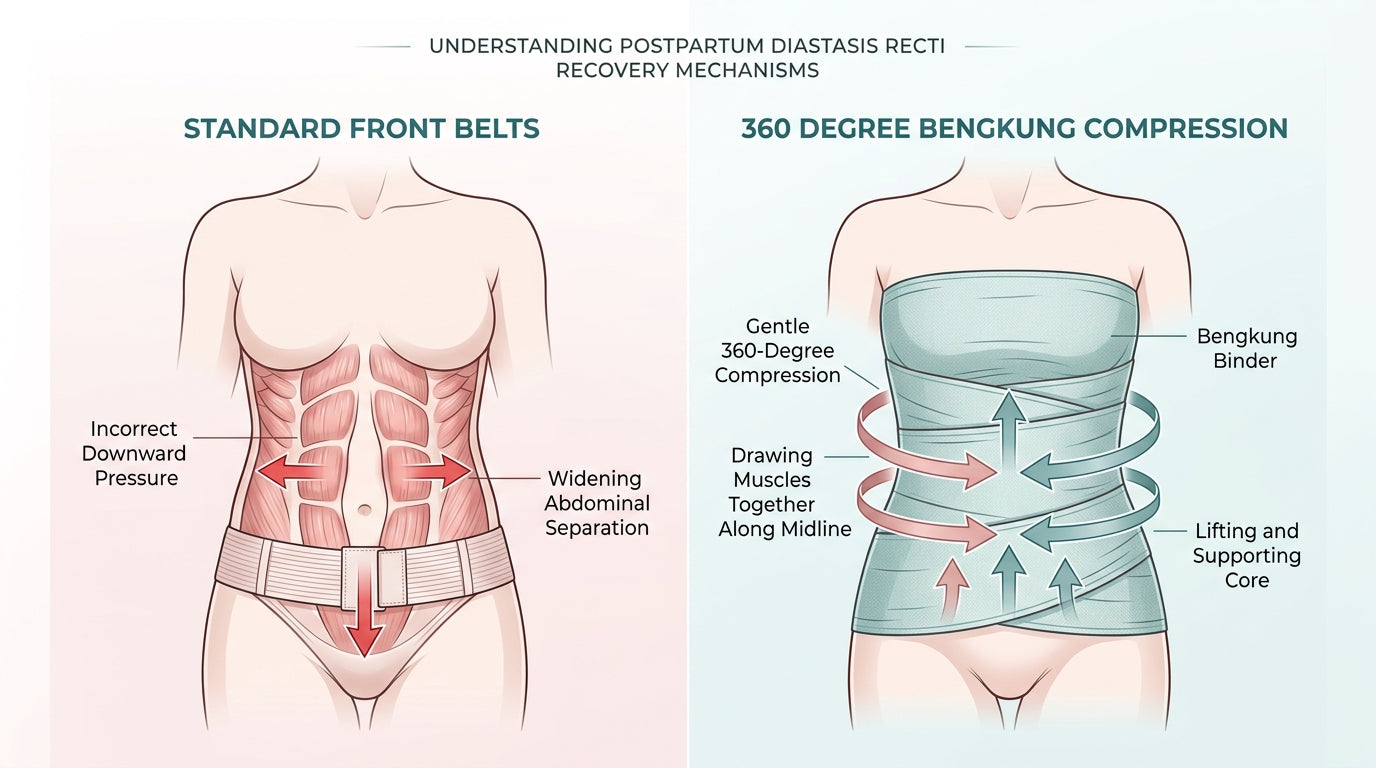
- Forces pressure down onto pelvic floor
- Squeezes front-only, pushing sides outward
- Widens abdominal separation & creates coning
- Uniform circular hoop tension holds entire core
- Gently draws left & right muscle bellies to midline
- Lifts the lower belly & unloads the lumbar spine
Introducing: The Naér 360° High-Waisted Postpartum Compression Shaper
The clinical modern evolution of the 500-year-old Malaysian Bengkung belly binding tradition — engineered for immediate comfort, zero roll-down, and true Diastasis Recti closure.

The Proof: Numbers, Names, and Real Moments
The Clinic's Price, Then Ours
Before you spend thousands on physical therapy or dangerous surgery, compare the real numbers:
The 30-Day 'Mirror Moment' Guarantee
Try the Naér 360° Shaper for a full 30 days. Slip into your favourite pre-baby outfit. If you don't feel an immediate wave of relief and see your post-baby belly smoothly supported, email us for a full, courteous refund. No hassles.
Answering The Last Questions & Objections
How soon after giving birth can I start wearing this?
For normal vaginal deliveries, you can begin wearing the Naér shaper AFTER 2 WEEKS Post partum. For C-section deliveries, we recommend waiting 3-4 WEEKS until your incision has initially closed and consulting your healthcare provider. The silky seamless lining is designed specifically to not chafe or catch on incisions.
Does it roll down when I sit down to nurse or bend over?
No! Traditional binders roll down because they lack vertical structure. Naér features 4 flexible medical-grade spiral stays embedded along the side seams and lumbar zone. They gently flex with your body as you nurse, bend, or sit, but prevent the waistband from rolling down into a tourniquet.
Will this work if I gave birth months or even years ago?
Yes! Connective tissue and fascial remodeling can occur years postpartum. While earlier is ideal, women who gave birth 1 to 5 years ago still experience substantial core stabilization, reduced lumbar strain, and significant visual flattening from 360° radial tension.
How does this differ from regular high-waist shapewear?
Standard shapewear acts like a flat elastic tourniquet: it compresses front-to-back, displacing intra-abdominal pressure downward against your healing pelvic floor and widening the muscle gap. Naér uses circular 360° hoop compression inspired by Malaysian Bengkung binding, lifting and drawing the rectus abdominis inward to the midline.
How do I choose the correct size?
Please use our easy size chart based on your current postpartum waist and hip measurements. If you are between sizes, we recommend sizing up for all-day comfort. Remember, our 30-day exchange policy guarantees you get the perfect fit with zero stress.
How many hours a day should I wear it?
For optimal core restoration, we recommend wearing it 6 to 10 hours daily during active waking hours. Remove it before sleeping. The breathable honeycomb mesh ensures you stay cool and comfortable all day long.